By: Nasser Omer Ali — May 23, 2026
As Eritrea marks 35 years of independence, the series “Do We Know Each Other’s Treasury?”, attempts to reflect not only on the country’s political journey, but also on the fears, memories, misunderstandings, and emotional distances that continue to shape relations between Eritreans themselves.
Part 1 challenged one of the deepest assumptions held by many Eritrean Muslims: the idea that Eritrean Christians, especially Tigrinya-speaking highlanders, form one unified political and civilizational bloc. The article explored the diversity, fragmentation, denominational boundaries, localized identities, and historical complexity inside Eritrean Christian society itself. It argued that reducing millions of people into one permanent political organism eventually destroys coexistence itself.
The reactions were revealing. Some readers agreed that Eritrean Christians are far more internally diverse than Muslims often assume. Others argued that such differences become meaningless whenever questions of power, land, or identity arise. Some insisted that Muslims should stop “diving into the deep sea of Tigrinya internal diversity” because, in their view, Christians ultimately unite when collective interests are threatened. Others pointed toward movements such as Agazianism as proof that deeper anti-Muslim political instincts continue to exist beneath denominational and regional differences.
Some reactions reflected accumulated mistrust tied to colonial alliances, Ethiopian annexation, anti-Muslim exclusion, and post-independence nation-building fears. Others emotionally generalized all Christians as hostile to Islam itself. But these reactions revealed something deeper: mistrust inside Eritrean society did not emerge from nowhere. It grew out of history, fear, political trauma, and inherited memories of domination and exclusion.
At the same time, the Eritrean Christians misunderstand Islam and Eritrean Muslims in ways that are equally deep and emotionally rooted. To be clear, this discussion is not attempting to reduce all Eritrean Christians into one category after Part 1 argued against exactly that kind of simplification. The focus here is specifically on those who actively shape political discourse — whether as regime supporters, opposition figures, ideological activists, nationalist movements, or identity-politics actors.
Before speaking about Eritrean Muslims, perhaps we must first ask another uncomfortable question: who exactly are Eritrean Muslims? Are we speaking about the Tigre-speaking communities? The Jeberti communities? The Saho-speaking communities, themselves internally diverse and including groups such as the Asaorta and others? The Afar-speaking communities? The Hidareb? The Rashaida? The Nara? The Bilen Muslim communities? The Kunama Muslim communities? The urban Arabic-speaking populations? The village-based pastoral societies? The religious conservatives? The secular Muslims? The Sufi traditions? The reformists?
Because one of the deepest misconceptions among Eritrean Christians is the assumption that Eritrean Muslims form one unified political camp driven by one agenda, one fear, and one historical memory. Reality itself disproves this. Eritrean Muslims are as internally layered, regionally fragmented, politically divided, linguistically diverse, and historically complex as Eritrean Christians themselves.
Geography itself shaped Eritrean political consciousness. Eritrea was never one socially uniform space. The highlands, western lowlands, Red Sea coast, pastoral regions, agricultural zones, trade corridors, and borderlands all experienced colonialism, Ethiopian annexation, war, religion, language, and survival differently. Communities in the lowlands and western regions encountered Ethiopian imperial expansion earlier and more directly, especially where questions of religion, land, and identity became politically sensitive much sooner.
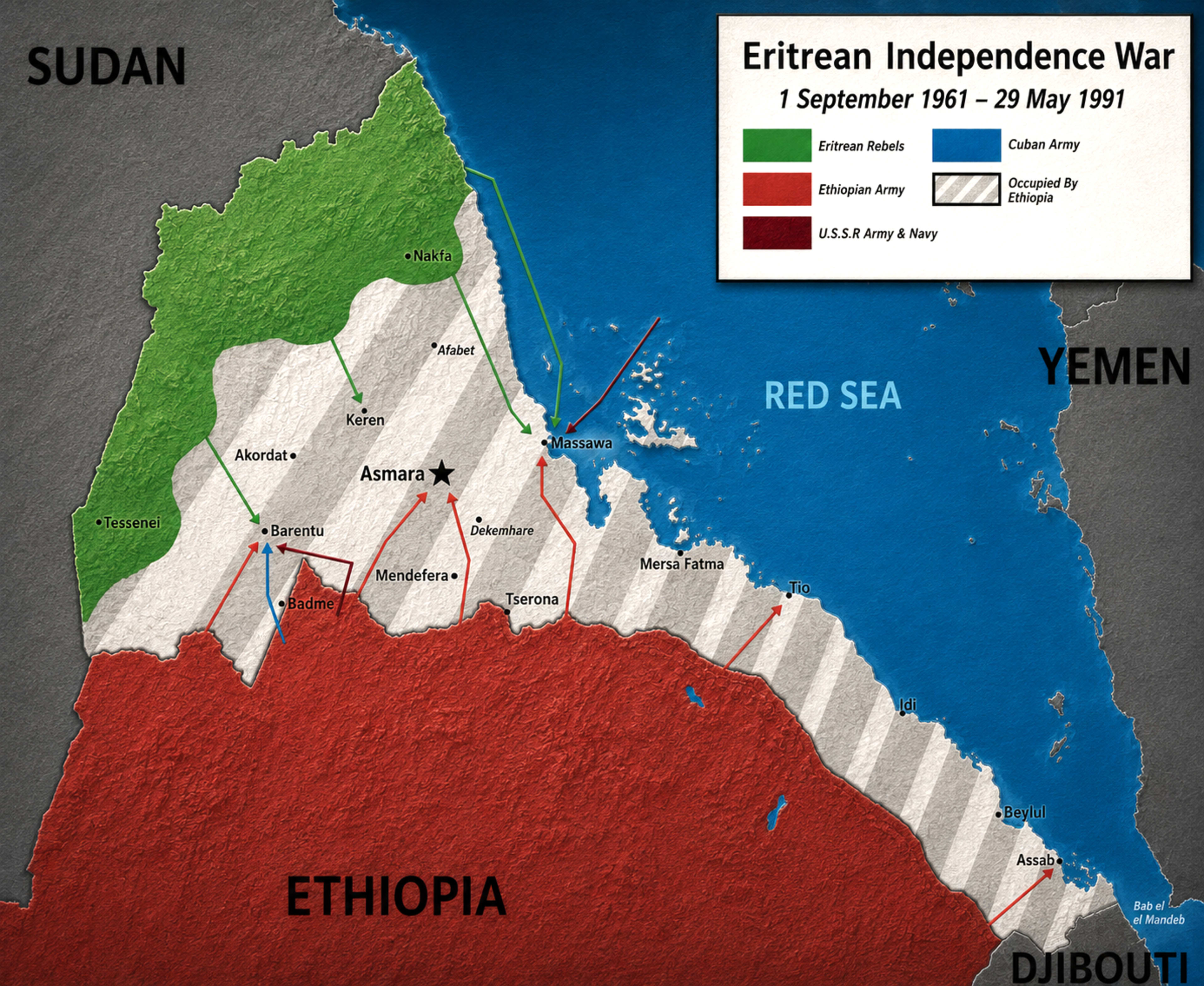
This partly explains why the earliest waves of armed resistance initially emerged more heavily from Muslim lowland and border communities before later expanding more broadly into the highlands. The ELF therefore developed a stronger Muslim and lowland image not simply because of ideology, but because certain regions entered armed confrontation earlier than others due to their geographic, political and historical realities. Later, as the struggle expanded deeper into the highlands, the social composition of the revolution itself gradually changed.
The same diversity that helped build the Eritrean revolution also later contributed to mistrust, fragmentation, and violent division inside the liberation movement itself. Eritrea’s diversity became both its revolutionary strength and its political vulnerability.
Another misunderstanding surrounding Eritrean Muslims is the obsession with national demographic percentages.
The fact that a community represents a single-digit percentage nationally does not automatically make it socially or politically a minority in the way people emotionally imagine. In Eritrea, local realities often mattered more than abstract national arithmetic. Communities experienced themselves not as minorities but as rooted majorities with historical continuity, language dominance, and ancestral belonging within their own environments.
A Tigre-speaking Muslim in the western lowlands grows up hearing his language everywhere around him just as naturally as a Tigrinya-speaking Christian in Hamasien grows up hearing Tigrinya dominate everyday life. Especially in a country where “less” historically often meant sacrificing more. Many communities that appear numerically small on paper paid enormously for Eritrea through martyrdom, exile, displacement, disability, destroyed villages, economic marginalization, and decades of underdevelopment under occupation. Their attachment to Eritrea was never merely demographic. It was existential.
Eritrean Christians also fail to fully understand that for Eritrean Muslims, Islamophobia was never an abstract future fear. It was a lived history. Many Muslim communities experienced generations of political marginalization, cultural suspicion, suppression of Islamic institutions, and attempts to build national identity through a dominant Christian framework.
As a result, Independence for Eritrean Muslims was never simply about borders or sovereignty. It represented psychological refuge — a safe homeland where Muslims would no longer fear political reduction, cultural erasure, or forced assimilation into someone else’s civilizational identity.
This is why Eritrean Muslims became disappointed much earlier than people assume — not simply because of dictatorship itself, but because of the nation-building direction the regime chose immediately after independence.
Eritrean Muslims also quietly resent what they see as the regime’s performative approach toward Muslim visibility. During official festivals and state ceremonies, the government often stages carefully controlled images of “Muslim representation,” sometimes by dressing selected Eritrean Christians in symbolic Muslim attire or presenting sanitized cultural performances detached from the deeper religious realities of Muslim communities.
For Eritrean Muslims, this does not feel like genuine recognition. It even feels insulting, especially when the symbolism contradicts Islamic teachings or reduces Muslim identity into folklore rather than a living spiritual tradition. What Eritrean Muslims seek is not cosmetic visibility, but dignity, trust, equal citizenship, and authentic inclusion within the national story itself.
There is also a painful emotional contradiction many Eritrean Christians often fail to notice. Ethiopian Muslims today enjoy levels of religious visibility, educational growth, and public participation that were historically difficult to imagine under earlier imperial systems. Part of that transformation emerged from the destabilization and resistance pressures created by the Eritrean armed struggle itself — a struggle in which Eritrean Muslims played a disproportionately early and significant role. Yet Eritrean Muslims today feel that they themselves ended up in a far more restricted political and religious environment inside the very independent state they sacrificed to create.
That leaves behind a difficult bitterness: the people who fled political and cultural marginalization in search of refuge now feel less free than the Muslims who remained inside the state they once resisted.
So for Eritrean Muslims, the issue was never primarily the language the aggressor spoke, the ethnicity he belonged to, or Christianity itself. The issue was justice. A Muslim oppressed by a Tigrinya-speaking ruler, an Amharic-speaking ruler, an Arabic-speaking ruler, or even a Muslim ruler would still experience oppression as oppression.
What Eritrean Muslims historically resisted was not language or ethnicity in themselves, but systems of domination, exclusion, forced assimilation, and political hierarchy. Over time, Eritrean Muslims developed the perception that some politically active Christian circles would ultimately prefer a Christian dictator over a just Muslim ruler whenever questions of communal fear or identity became politically sensitive.
Whether entirely fair or not, that perception did not emerge from nowhere. It grew from accumulated historical experiences, selective political memory, and repeated moments where sections of Eritrean political discourse appeared more willing to tolerate authoritarianism than the possibility of Muslim political leadership.
Another misunderstanding Eritrean Christians carry is the idea that Islam is somehow foreign to the land while Christianity alone is naturally indigenous to the region.
Historically, the reality is more complicated. Yes, Christianity arrived in Abyssinia before Islam. But both religions ultimately came from outside the region. Neither was born in the Eritrean highlands.
The Horn of Africa occupies a unique place in Islamic history itself. It was here that the first Muslim asylum outside Mecca emerged. It was here that some of the earliest Muslim communities found safety. According to many Islamic traditions, one of the earliest mosques outside Arabia itself was established in this region long before Islam spread across much of the wider world.
Sometimes people even joke that the reason the Ge’ez calendar is years behind the Gregorian calendar is because the news of Jesus’ birth reached Abyssinia late. The joke may not be historically serious, but the deeper point matters: Abyssinia was never the exclusive civilizational property of one religion alone.
Islam in Eritrea was not imported yesterday by foreigners. It has existed in the region for centuries through trade, scholarship, migration, intermarriage, coexistence, and shared historical experience alongside Christianity itself. To many Eritrean Muslims, Islam is not an external guest in the land. It is part of the land’s own historical memory.
Eritrean Christians misunderstand why Muslims historically supported Arabic.
For Eritrean Muslims, Arabic was often viewed as a possible unifying language across Eritrea’s enormous ethnic and linguistic diversity without allowing one local language to dominate the others.
What Eritrean Christians also miss is that much of the modern Arab nationalism emerged not from Islamic theology, but from secular nationalist currents associated with Ba’athist ideology by principal architects of Ba’athism like, Michel Aflaq, who was an Orthodox Christian Syrian intellectual. Arabism therefore functioned politically in much the same way other identity-based mobilization frameworks function elsewhere: language as political glue, civilization as emotional mobilization, and historical memory as a unifying narrative.
In that sense, Arabism was not fundamentally different from the way some Eritrean Christian political currents use Tigrinya, Orthodox Christianity, or broader Abyssinian civilizational narratives to mobilize highland populations across Eritrea, Tigray, and Amhara.
Another misunderstanding many Eritreans inherited is the simplistic idea that the ELF was “the Muslim organization” while the EPLF was “the Christian organization.”
Historically, reality was far more fluid.
At the beginning, revolutionary movements often carry the social image of their founders and early recruits. Since the ELF initially emerged largely from Muslim lowland political networks reacting earlier to Ethiopian annexation, it naturally developed a stronger Muslim image during its formative years. Later, the EPLF emerged with stronger participation from highland communities and gradually acquired a more Christian and highland image in the public imagination.
But liberation wars constantly consume and replace generations through martyrdom, recruitment, displacement, exile, and expansion. The demographic composition of both organizations changed continuously over time.
Another important misunderstanding concerns historical memory itself.
Within large segments of Eritrean Christian political culture, especially among highland communities influenced by Ethiopian imperial narratives, such as the campaigns of Imam Ahmed Gragn and later Ottoman influence are often remembered as the ultimate trauma, a contradiction that reveals how selective historical memory can become.
For Eritrean Muslims the deepest historical trauma was the successive Ethiopian imperial systems extending into the Haile Selassie era. In Muslim historical memory, the deepest wounds were tied to annexation, cultural marginalization, suppression of Islamic institutions, political exclusion, and anti-Muslim nation-building strategies.
Many Eritrean Christians even spoke differently about the Derg period despite its brutality because the communist regime targeted nearly everyone regardless of religion. Mengistu’s dictatorship was experienced by many as equal-opportunity authoritarianism and earned him the name “Muhammad Mengestu” by both Ethiopian and Eritrean Christians alike.
Eritreans do not inherit history equally. And once they organize history around different narratives, they slowly begin fearing entirely different futures.
For Eritrean Muslims, Abyssinia itself was never originally imagined as an enemy civilization. In Islamic memory, Abyssinia carried spiritual dignity because it was the land that protected the companions of the Prophet Muhammad, peace be upon him, when they fled persecution from Mecca.
That memory matters deeply. It means that hostility toward the Ethiopian imperial system was never originally rooted in hatred toward Christians or Ethiopians as a people. It emerged from historical experiences of injustice, annexation, political domination, and bloodshed.
For Eritrean Muslims, therefore, Eritrean independence was never imagined as an anti-Christian project. It was imagined as a homeland where no community would again fear domination by another — a place where citizenship would matter more than religious hierarchy and justice would matter more than identity.
The tragedy today is that many Eritrean Christians increasingly misunderstand, not only Eritrean Muslims, but Islam itself through the imported fears, while many Muslims increasingly see Christians only through inherited memories of the empire’s oppression. And between those two fears, Eritrea itself slowly fails.
Support Eri Meeting Point
Keep independent media alive