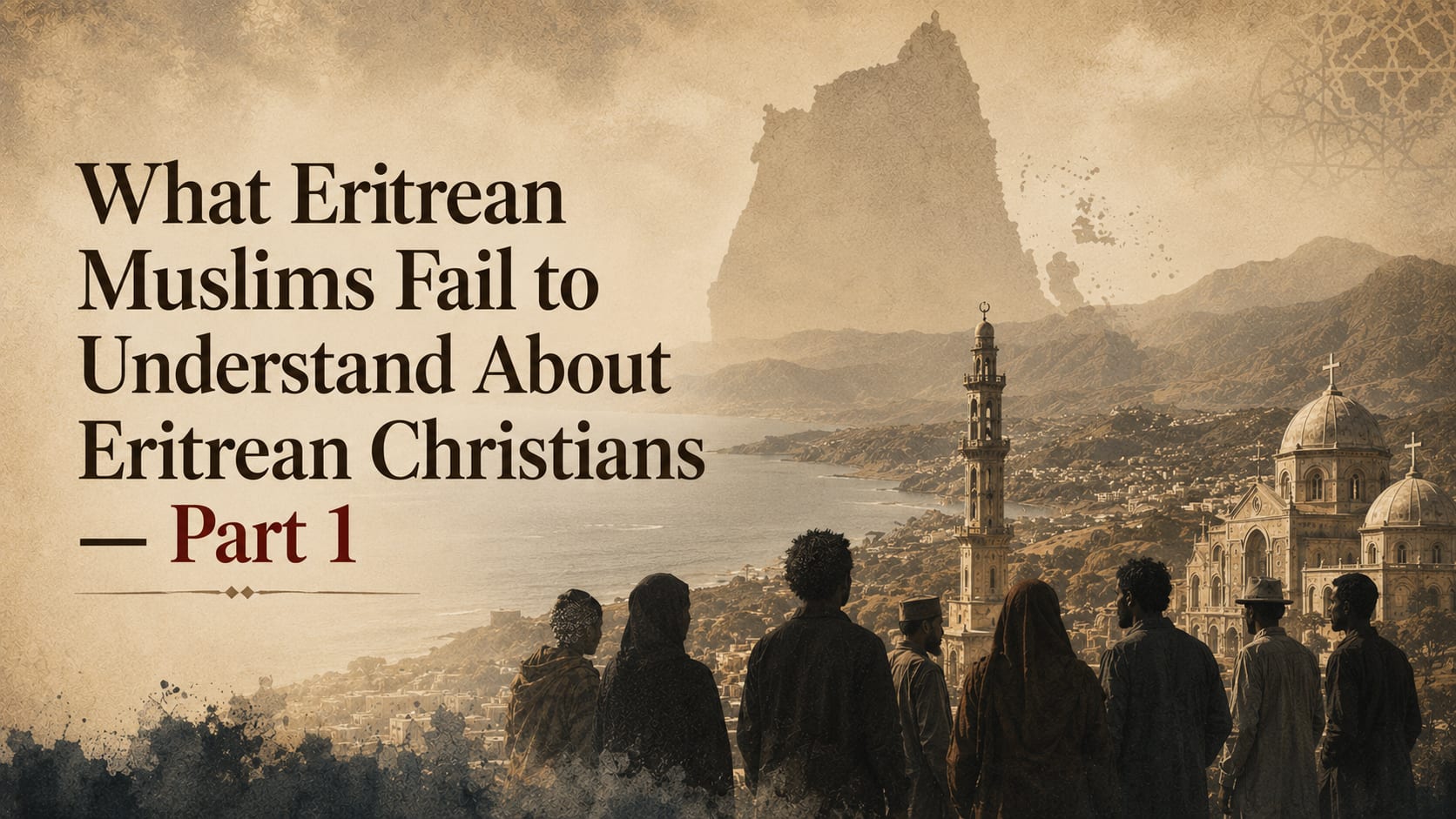
By: Nasser Omer Ali - May 18, 2026
Eritrea is often discussed as though its communities fully understand one another. Yet beneath the language of nationalism, coexistence, and shared struggle lies a deeper reality: Eritreans frequently inherit simplified versions of each other shaped more by fear, political memory, and historical trauma than by actual lived complexity.
This series, Do We Know Each Other’s Treasury?, attempts to explore those misunderstandings from multiple directions. Not to erase historical grievances, but to ask whether Eritreans have slowly stopped seeing the human, cultural, spiritual, and historical depth within one another.
Part 1 begins with a difficult but necessary question:
What do many Eritrean Muslims fail to understand about Eritrean Christians?
Before speaking about “Eritrean Christians,” perhaps we must first ask a more uncomfortable question:
Who exactly are the people we casually reduce into that single category?
Are we speaking about the Orthodox?
The Catholics?
The Protestants?
The Pentecostals?
The Jehovah’s Witnesses?
The secular Christians?
Who exactly are we talking about?
And when we say “the Christian highlanders” or “the Tigrinya people,” who exactly are we referring to?
Are we speaking about the indigenous Tigrinya-speaking peoples of Seraye?
Are we speaking about the indigenous Tigrinya-speaking peoples of Akele Guzai, many of whom historically interacted, intermarried, and culturally overlapped with indigenous local Saho, Asaorta, and Tigre communities?
Are we speaking about the Tigrinya-speaking peoples of Hamasien, themselves composed of different historical origins and layers, including the assimilated populations from other parts of the Horn of Africa over centuries?
Or are we speaking about populations that migrated during imperial periods, federation, annexation, colonial labor movements, or urban expansion and later became Eritrean citizens?
And when we say the Tigrinya-speaking peoples of Seraye, Akele Guzai, or Hamasien, are we speaking about the indigenous Tigrinya-speaking populations of all Christian denominations who themselves historically coexisted for centuries with the Muslim Tigrinya-speaking communities of the Jebertis that shared same language, markets, neighborhoods, trade, poetry, and everyday life despite religious differences?
Or are we speaking about the later politicized identity that attempted to erase all these complexities and recast every Tigrinya speaker into one rigid political category?
Because historically, Eritrean society was far more intertwined than modern political narratives now admit.
And perhaps we must ask an even more sensitive question.
When we say “Eritrean Tigrinya-speaking Christians,” what exactly do we mean?
Are we speaking about the indigenous village-based populations of Eritrea whose historical attachment was primarily to their land, farms, local customs, and ancestral villages rather than to imperial political power?
Communities that for centuries remained tied to agriculture, local administration, communal village life, and religious institutions while political and imperial authority above them was often dominated by rulers, administrators, clergy, and elites connected to Tigray or of Tigrayan origin?
Communities that historically produced very limited indigenous political elites of their own until the armed struggle itself helped create a new generation of indigenous Eritrean Tigrinya-speaking political and military leadership?
And is it not one of Eritrea’s great tragedies that many of those very indigenous Eritrean Christian elites produced during the liberation struggle later ended up imprisoned, marginalized, exiled or politically destroyed by a regime that itself is frequently accused of carrying stronger social, historical, or ancestral connections to the Ethiopian and Tigrayan political world than to the Eritrean Tigrinya populations it governs?
These are uncomfortable questions. But they matter because they expose how simplistic the phrases “Eritrean Tigrinya,” “Eritrean Christians,” or “Eritrean highlanders” truly are.
One of the greatest misconceptions
One of the greatest misconceptions among many Eritrean Muslims is the assumption that Eritrean Christians form one unified political and demographic majority with one collective consciousness and one common agenda.
But reality itself disproves this.
Even latest movements that attempted to construct such a unified identity collapsed instantly under the weight of Eritrea’s internal complexity.
The Zionist Agazian movement of this decade, for example, initially imagined a massive trans-border Tigrinya-speaking bloc stretching across Eritrea’s three highland regions and Tigray, presenting itself as an overwhelming demographic force capable of politically dominating Eritrea.
But even before such visions matured, they fractured internally. Soon, some of the same voices began redefining who truly belonged and who did not.
Seraye became “peripheral.” Akele Guzai became “peripheral.” Tigray itself became “peripheral.” Even Eritrea’s own president, Isaias Afwerki, who they used to claim him as their ideological father, was dismissed as “not one of us” but “from Tigray.”
In other words, the closer one looks at the supposedly unified identities, the smaller and more fragmented they become.
And perhaps we must go even further.
Can we even honestly treat all these denominations as one single religious community in the sociological sense?
The differences between some Eritrean Christian denominations are sometimes so deep that they are not necessarily smaller than some of the differences they have historically had with Muslims themselves.
For example, many traditional Orthodox communities historically did not freely intermarry with other Christian denominations. In some cases, they would not even eat meat slaughtered by other denominations because they did not consider it religiously acceptable, much in the same way they avoided meat outside their own religious standards, including Muslim slaughter practices.
Some communities historically carried such strict religious boundaries that even simple social interaction during fasting seasons became spiritually sensitive. In certain traditions, some believers would avoid even shaking hands with followers of another denomination or religion during fasting periods out of fear that their fasting discipline or spiritual purity would be compromised.
In many traditional highland communities, even in-laws and grandchildren through daughters are not automatically granted residency rights because of fears related to land inheritance, communal ownership, and the fragmentation of scarce farmland. Their attachment was often first to village, lineage, church, and survival long before any larger political identity.
Likewise, some denominations historically maintained separate burial grounds, and followers of other denominations were not always buried in the same cemeteries. Today, much attention is given to the denial of Muslim burial spaces in places like Aksum, yet far less discussion exists about how deeply internal denominational boundaries themselves historically operated within many Christian societies of the region. Alongside restrictions on intermarriage and food sharing, this reflected how deeply rooted, internally layered, and socially distinct Eritrean Christian society itself historically was.
This does not necessarily mean hatred. It reflects how deeply rooted and socially structured these religious identities historically were. And yet, despite these deep theological and denominational boundaries, Eritrean society still managed to produce something rare in the region: everyday coexistence.
A personal reflection
I grew up in Mendefera under the shadow of St. George Church. From our home, we could see the church clearly. My mother, though Muslim, understood the rhythm of its bells — the fasting days, the holidays, and the calendar of our Christian neighbors. And her Christian friends understood the sound of the Azan when Muslims were called to prayer.
I later attended a high school named after St. George himself. Only recently did I fully confront a strange irony: the very saint many Eritrean Orthodox Christians deeply revere was a Palestinian.
Today, many Eritrean Orthodox youth passionately defend Israel online while speaking suspiciously about Palestinians, Arabs, or Muslims. Yet St. George himself — belongs historically to the very land now witnessing occupation, bombardment, and the suffering of civilians.
The irony becomes even deeper when one learns that in Palestine itself, St. George was not historically viewed only as a Christian figure. Palestinian Muslims also honored him culturally. Muslim families visited his shrine alongside Christians. In his homeland, St. George represented coexistence rather than civilizational conflict.
But elsewhere, particularly in parts of the modern West, the symbol of St. George was gradually transformed into a banner associated with exclusionary nationalism and anti-immigrant rhetoric.
And now some Eritrean youth, themselves descendants of a society built on Muslim-Christian coexistence, increasingly consume imported ideological narratives that detach St. George from his own people.
How did a generation raised venerating a Palestinian saint become emotionally indifferent to Palestinian civilian suffering?
How did St. George become more real than the people of St. George’s own homeland?
Perhaps this is what many Eritrean Muslims fail to understand about Eritrean Christians:
Behind the politics, fears, and contradictions lies a community with deep spiritual memory, emotional complexity, and a long history of coexistence that should not be reduced to modern ideological camps.
- Eritrean Christians are not one block.
- They are not one tribe.
- They are not one political organism.
Like Eritrean Muslims, they are internally layered, historically mixed, regionally fragmented, politically divided, and psychologically diverse.
- Some are deeply nationalist.
- Others are deeply spiritual but politically detached.
- Some fear political Islam.
- Others fear authoritarian nationalism.
- Some feel culturally connected to the wider Abyssinian world.
- Others reject that identity entirely.
- Some themselves feel marginalized despite being perceived as part of a majority.
And perhaps that is the greatest irony in Eritrean politics:
Both Muslims and Christians often behave like frightened minorities while imagining the other side as a dominant majority.
A shared historical foundation
But beyond all these divisions lies something even deeper that many Eritrean Muslims fail to appreciate.
Eritrean Christians possess one of the oldest and richest spiritual traditions in the region. Ironically, Islamic tradition itself preserved respect and closeness toward sincere Christians. The first sanctuary Muslims ever found was under a just Christian ruler in Abyssinia who protected the companions of the Prophet Muhammad, peace be upon him, from persecution.
That history matters.
It reminds us that the relationship between Muslims and Christians in this region, specially in Eritrean, did not begin with hatred, but with justice, coexistence, and moral recognition.
Yes, Eritrean Christians, like everyone else in the region, were affected by nationalism, communism, armed struggle, militarization, and authoritarian politics. Some absorbed dangerous ideas of superiority. Some became fearful and defensive.
But those forces did not destroy their humanity.
Despite everything, Eritrean Christians remain among the most spiritually rooted, socially grounded, and community-oriented populations in Eritrea.
And perhaps Eritrea will only begin healing when Eritreans, both Muslims and Christians, stop reducing one another into political caricatures and begin rediscovering each other’s human treasury once again.
Nassir Omer Ali
Support Eri Meeting Point
Keep independent media alive